Culture

The Municpality of Monemvasia, like other parts of the Peloponnese, boasts a large number of historic monuments that have survivied the passage of time. Ranging from prehistoric to classical, Byzantine to the more recent past, these include the unique medieval fortress of Monemvasia, with its well-preserved buildings of the Lower and Upper Towns, and the exhibits in the Monemvasia Archaeological Collection.

Meanwhile the folklore musuems of Velies and Riechia provide a wealth of information about the region’s daily life and culture.

The Christian tradition, another important aspect of the region’s history, is represented in dozens of churches and monasteries that are witness not only to the local population’s spiritual life but the skills of their master craftsmen and artists who built and decorated these places of worship.

Cultural life in the Muncipality of Monemvasia today takes the form of all kinds of events such as concerts, theatrical performances and art exhibitions. The biggest cultural festival is the Ritseia, a major celebration in summer dedicated to the poet Yannis Ritsos, Monemvasia’s most famous son, whose work has received recognition around the world.

Church of Profitis Ilias

The stark white outline of the little church of Profitis Ilias stands sentinel above the little fishing cover of the same name.

The altar is built-in and some of the church’s icons are excellent examples of early 20th century folk art. It is a popular choice for weddings and baptisms.

According to local oral traditions, there is a particular reason why this seaside church received its name, one usually associated with chapels on mountain peaks. About two centuries ago, a raiding ship was heading for the cape bearing a Greek shepherd as a prisoner, battling heavy seas that threatened to sink the vessel. The prisoner offered up a prayer to Profitis Ilias, the patron saint of shepherds. The captain was so frightened that he promised to build a church to the saint if his prisoner’s prayers were answered.The ship eventually found refuge in the little cove where the church was built in accordance with the captain’s vow.
Access

The church and the settlement of the same name, lie about 7 km south of the village of Aghios Nikolaos. The  church is on hiking route D12

Location:
Profitis Ilias settlement, near Aghios Nikolaos Vion


Aghios Athanasios-Pantanassa

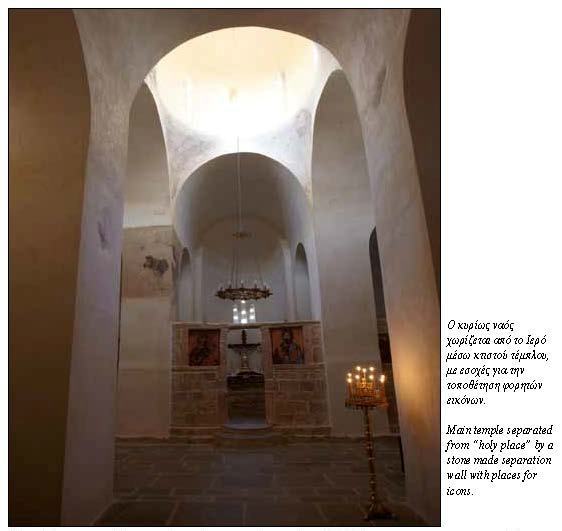
The Byzantine church of Agios Athanasios, dedicated to Virgin Mary, Saint Athanasios and Saint Spiridon, is located a few kilometres outside the village of Pantanassa, which was named after the church.

Tradition has it that the church was built by Irene Palaiologou, the daughter of King Andronikos Palaiologos in 1300 AC. However, it was later proved that the church was built in the12th century.

The church is a five domed, octagon rhythm, cemetery and triune temple that has a lot of similarities with Pantanassa church at Mistras Castle and Pantanassa church in Arta.

The hiking route that starts from the church’s countryard leads through an astonishing green scenery to the Princess’s Castle.


Access

Agios Athanasios of Pantanassa is located halfway on the road connecting Molai with Neapoli.

There is parking space outside the church.

Location:
Pantanassa
Information:
If you wish to see the inside of the church, you should contact the priest of Pantanassa.

Telephone number: 6972122653

Free entrance