A large number of historic monuments are scattered throughout the Municipality of Monemvasia. As in the rest of the Peloponnese, there are numerous reminders of the region’s turbulent history of invasion and wars, but also of its human achievements.

Its past history emerges in the writings of that traveller of antiquity, Pausanias, who described in detail the most important monuments in the region, such as the town of Epidaurus Limera, still prosperous when he visited it, and traces of which still stand facing Monemvasia. Ruins of other ancient towns still remaining include Ancient Kyphanta, at Kyparissi, and the fortress of Zarakas, at Gerakas.

The Municipality of Monemvasia is perhaps one of the only places in the world where there are not one but two submerged ancient towns – the prehistoric settlement of Pavlopetri near Neapoli and the ancient town of Plytra, at Asopos, both now largely under water as the result of seismic activity throughout the Maleas peninsula. The ruins of both are visible to swimmers using goggles and snorkels.

The existence of a number of fortresses shows that the region was subjected to repeated invasions. From antiquity, but particularly in the Middle Ages, the local population was forced to fortify its settlements in order to survive the repeated wars, invasions and pirate raids. The most important of all – and one of the most beautiful medieval towns in the Mediterranean – is the fortress of Monemvasia, for many centuries an invincible bulwark but also a place of prosperity and culture.

Smaller fortresses and fortification works worth visiting include the fortress of Aghia Paraskevi near Mesochori, and the ruins of Palaiokastro at Papadianika.

A military monument from the more recent past is the German Watchtower built during the World War II occupation above the village of Velanidia, near Cape Maleas.

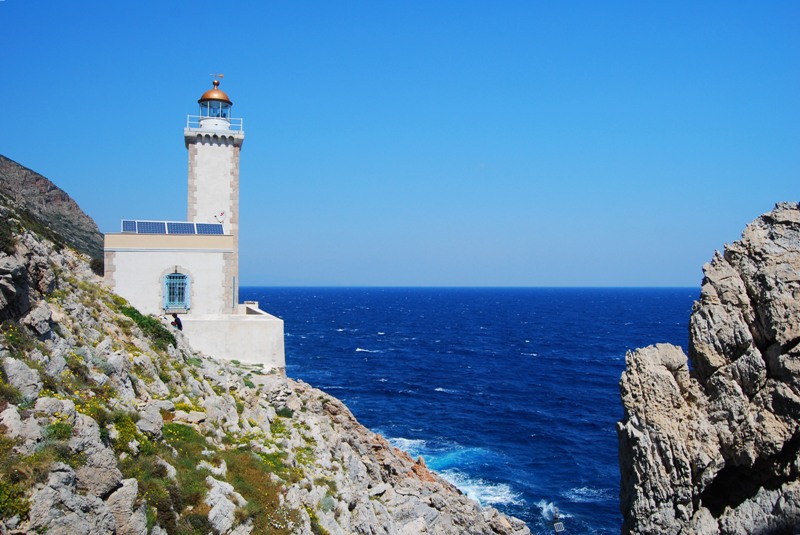
Reminders of more peaceful times include the watermill at Talanta and the folklore museums at Velies and Riechia. Finally, the recently restored Cape Maleas lighthouse is a sight not to be missed.

Fortress town Monemvasia

The Byzantine fortress town of Monemvasia, the “stone ship” referred to by the poet Yiannis Ritsos, stands sentinel on the southeastern coast of Laconia, ready to take its visitors on a historic journey back through the ages.

Castles, walls, old mansions, narrow cobbled lanes, churches, low arches and vaults, coats of arms, imperial marble thrones, Byzantine icons all give the impression of a town untouched by time.

Referred to variously throughout the ages as the Gibraltar of the East, the Castle above the Clouds, or the Castle of Flowers, among others, it is situated on a small islet linked to the mainland by a causeway and bridge, as if floating on the edge of the Myrtoon Sea.

The single entrance that gives the rock its name (moni emvasia in Greek) is a passageway into its past, beginning in the 6th century AD.

As one enters the main gate of the Lower Town, immediately above it to the left is the birthplace of the poet Yiannis Ritsos. The main thoroughfare, consisting of a narrow cobbled Byzantine street flanked by shops, leads to the main square dominated by an old cannon and the town cathedral, the Church of Elkomenos Christos. Directly opposite the church is a 16th century former mosque now housing the Monemvasia Archaeological Collection.

From the main square a number of picturesque narrow streets fan out over the Lower Town.

One of these leads to the Upper Town or Goula, a steep climb taking about 15 minutes, but a rewarding one for the panoramic view of the Lower Town and the surrounding open sea glittering below.

Visit the restored church of Aghia Sofia, built on the cliff edge.

In all there are 40 churches in Monemvasia, including the Panayia Chrysafitissa, Panayia Myrtidiotissa, Panayia Kritikias, Aghios Nikolaos, Aghios Stefanos, Aghios Pavlos and Aghia Anna, as well as the silver and gold workshop and museum.


VIDEO


Location:
Monemvasia
Information:
Monemvasia is accessible by road from Athens by car or intercity bus, or by sea from Pireaus in summer months.

A surfaced road leads from the new town of Monemvasia (Gefyra) over bridge to the gates of the lower town, where parking is extremely limited. However, there is a regular mini-bus service between the new town and the fortress.

Cape Maleas Lighthouse

Cape Maleas is at the southern-most point of the Greek mainland. Its stone lighthouse, built in 1860, first went into operation in 1883 and in 2006 was designated a listed monument.

One of the most important lighthouses in Greece it known to seamen the world over.  Sailing past Cape Maleas has always held many potential dangers and has often been a seaman’s nightmare, even referred to as such in ancient texts.


Access

The footpath to the cape is one of the most famous hiking routes in the area (7.8km from the village of Velanidia – the D10 route).Drive from Velanidia to Aghios Miros where the path begins. Continue on foot towards the cape with the sea on your left.

Access from the sea is extremely difficult and anchoring is impossible.

Location:
Cape Maleas


Information:
The Greek Navy has posted lighthouse keepers who also give informationto visitors.

Free entrance